Firmware Dev Cycle, Stop waiting.
How a Godot GDScript habit turned into a sub-2-second Zephyr hot-reload trick — trading an MPU for iteration speed so an AI coding agent can actually pair on real firmware.
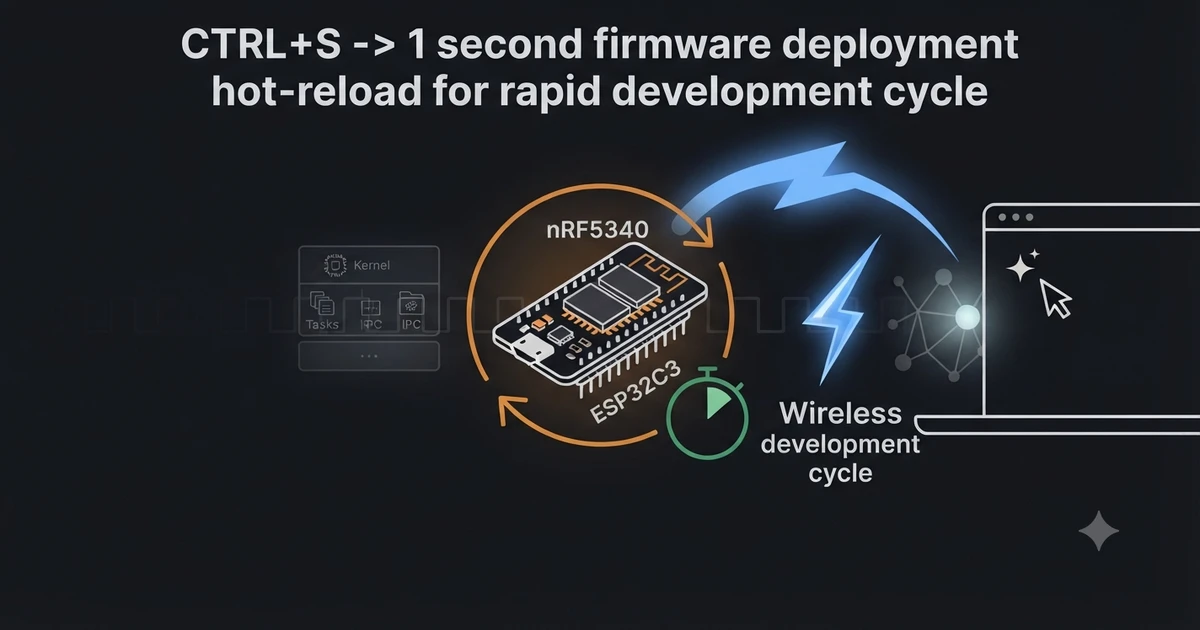
I’ve spent a lot of hours in Godot outside of work — genuinely a lot, not a weekend dabble — and the thing that hooked me wasn’t the engine, it was the loop. Edit a .gd script, hit save, and the change is just there, live, in the running scene, no restart. I loved it enough that it planted an annoying question: why does firmware feel nothing like this? A Zephyr west build && west flash cycle is a coffee-break by comparison — tens of seconds to minutes for a change that, in Godot, is invisible because it’s instant. So I went and built the firmware equivalent, on real hardware (an ESP32-C3 and an nRF5340 DK), and it’s the reason an AI coding agent could actually pair with me on this project instead of babysitting a rebuild.
The trade: MPU off, in exchange for speed
The trick, honestly stated, is an abuse of the hardware, not a clever optimization of the normal flow. Instead of relinking and reflashing the whole firmware image every time one small piece of logic changes, small native-C modules — I call them blobs — get compiled standalone, linked to run at one fixed address in RAM, and pushed onto the running device over BLE. No bootloader handoff, no image swap, no reboot: the host just memcpys the bytes into that RAM slot and jumps into it. That’s only possible because the MPU is deliberately left off for this build — with memory protection on, jumping into a RAM address the CPU doesn’t expect executable code at faults immediately. Turning that protection off is the whole point and the whole risk, and it only belongs in a dev build. This is not a technique I’d ship to a customer.
Measured, end to end, edit to running-live-on-device: 0.8–0.9 s unsigned, 1.8–2.1 s signed (the signed path spends most of that on-device doing ECDSA-P256 verification before it’ll run the blob at all). That’s the number that made the whole thing worth building — it’s the same order of magnitude as the Godot loop that started this.
A few things make it survivable as a habit rather than a novelty:
- Blobs are position-fixed to whatever image is currently flashed. Any host rebuild can move the RAM slot’s address, so the loader always relinks against the ELF that’s actually on the device right now — never a cached build artifact. Skipping that check is how you get a jump into garbage.
- The host/blob interface is versioned directionally. The struct the host owns can safely grow (host controls that memory); the struct the blob owns can’t be appended to without a version bump, because a newer host reading a new field off an older blob’s struct is reading blob code/data as if it were a function pointer. Get this backwards once and you’ll believe you have a heisenbug for a week.
- A fault gets contained to one slot, not the whole board. If a bad edit crashes inside a blob’s own execution context, only that slot’s task restarts — the rest of the system, including the BLE link the crash report comes back over, keeps running. That’s what makes “just try it and see” a reasonable way to iterate instead of a 50/50 bet on a J-Link trip.
What it’s actually for: a logic analyzer
The excuse to build all this was a Saleae-style I2C/SPI logic analyzer, because it’s a nice adversarial target for a fast-iteration loop — you’re constantly tweaking trigger conditions and decode logic against real bus traffic. The capture engine (edge-timestamped sampling, hardware-timed via GPIOTE+DPPI+TIMER on the nRF53) is the one piece that stays flashed; every decoder — the thing that turns raw edges into “this was an I2C START, this was a STOP” — is a hot-reloadable blob. Change a trigger condition, push it, watch real bus traffic hit the new logic in under two seconds, repeat. That loop is also why a coding agent could pair on this at all: an agent proposing a dozen small logic tweaks in a session is only as fast as the slowest step in its own feedback loop, and a sub-2-second one keeps “try it” cheaper than “reason about it first.”
Decoded events stream off the device over their own dedicated BLE characteristic — deliberately not the text shell channel, because a shell rewrites \n to \r\n and mangles arbitrary binary. On the ESP32-C3 that stream sustains 65–70 kB/s (roughly 1,600–1,700 records/s) with bursts up to 132 kB/s and zero record loss across a 6,000-record test — good enough throughput that the bottleneck in practice is the decoder logic, not the transport.
The loop, and a schematic of the event stream
The point is the order of magnitude. Firmware has historically been the slow outlier by a factor of 20–100×, not because the problem is harder, but because nobody bothered to build the equivalent of what Godot and a JS dev server already do by default. Closing that gap is what actually made an agentic session on real hardware feel normal instead of painful.
Where it honestly stands (not for production, but for in-house development)
It’s a development-loop trade, full stop — a wild write from a buggy blob can still corrupt host state, signing (where it’s used) authenticates who wrote the blob, not that the code is safe, and rollback is recorded but not enforced. None of that matters for a dev rig on my desk; all of it would matter enormously anywhere else.
What I keep coming back to, though, is the Godot thread through this. I didn’t set out to build a “hot-reload framework” — I set out to keep playing in an engine that respected my time, then got annoyed that firmware didn’t, and built the thing that made it stop being annoying. That’s a fine reason to build something.